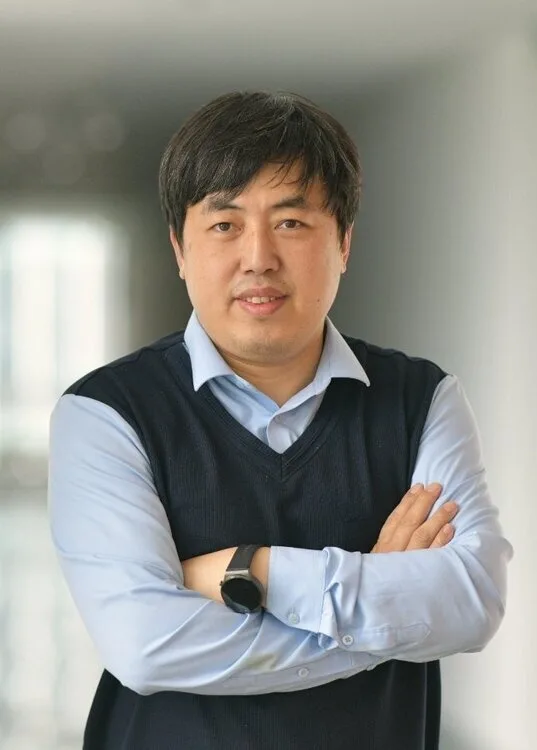
CAM Colloquium - November 13, 2026, April Wei "The ancestral recombination graph: latent structure for compression and inference in population genetics"

Title: The ancestral recombination graph: latent structure for compression and inference in population genetics
Abstract: The genomes within a species are related through an ancestral recombination graph (ARG), a sequence of genealogical trees along the genome that encodes the coalescence and recombination history of the samples. While genome sequences can now be observed directly, the ARG remains the latent object that is difficult to infer. Yet, it underlies most questions in population genetics, and its structure can be exploited both to compress the genotype data and to compute data likelihoods. I will describe two lines of work from my group. The first is the development of the genotype representation graph (GRG), a simpler ARG-like graph that encodes shared haplotype structure among samples. The GRG is a lossless encoding of the genotype matrix, equivalent to a factorization of the matrix into sparse factors, so that a matrix-vector product can be computed by a single graph traversal or a sparse triangular solve. For the phased UK Biobank whole-genome sequencing data, the genotype matrix has 6.9 × 10^14 entries and would occupy 87 TB stored densely at one bit per entry; the GRG files total 122 GB, and operating directly on the GRG speeds up statistical methods by orders of magnitude. The GRG can also be utilized as an intermediate step for scalable ARG inference. The second is demographic inference from an inferred ARG. Under the structured coalescent model, the genealogical history follows a continuous-time Markov chain whose rate matrix exponential gives the distribution of pairwise coalescence times, with population splits and admixture entering as linear maps between state spaces at epoch boundaries. We estimate migration rates, population sizes, and admixture proportions by maximizing a composite likelihood over all pairwise coalescence times in the ARG, with uncertainty quantified by the Godambe information. The talk will begin with an introduction to John Kingman’s coalescent theory and conclude with open problems in the era of ARGs.
Short Bio: Xinzhu "April" Wei is an Assistant Professor of Computational Biology at Cornell University. She develops mathematical and computational methods for population genetics, including graph-based data structures for biobank-scale genomics and statistical methods for inferring demographic and selection history.
Kilde: events.cornell.edu