Ezra Systems Seminar: Alexandra Werth (Cornell BME)
Making Learning Visible: Reflection, GenAI, and Measurement in Authentic Learning Environments
Authentic learning environments, such as capstone design or undergraduate research experiences, give engineering students opportunities to practice being an engineer. These environments ask students to navigate uncertainty, exercise judgment, and learn through collaboration. Yet measuring this learning is challenging, particularly across engineering’s diverse educational contexts. Students’ written reflections offer both a way to support learning and a window into how they make sense of their experiences. How can we use these rich, traditionally qualitative accounts to investigate patterns in learning across students and settings?
Our research addresses four connected challenges: eliciting substantive reflection, establishing what students’ accounts can tell us about the learning we value, interpreting those accounts reliably, and producing findings that can inform educational practice. This seminar focuses on developing methods and tools that elicit deeper student reflection and support reliable analysis, drawing on both pedagogical design and new capabilities of generative AI.
I will share work exploring AI-personalized short-form reflections and longer reflective memos, alongside human and AI-assisted approaches to analyzing students’ writing. These examples bring questions of validation, interrater reliability, and the role of course context into focus. Together, they contribute to a broader effort to develop measurement approaches that preserve the richness of students’ experiences while supporting research across learning environments and helping instructors improve their own courses.
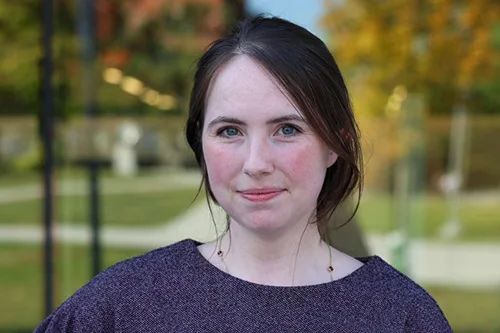
Bio: Alexandra Werth is an assistant professor in Cornell University’s Meinig School of Biomedical Engineering and a core faculty member of the Duffield Engineering Education Research Institute. She directs the Biomedical Engineering Education, Assessment, and Research (BEEAR) Lab, where her group studies how students learn and develop as engineers through research, design, and other authentic learning experiences. Her work examines reflection, feedback, and teamwork while developing human and generative AI-assisted methods for studying learning across educational contexts. She leads NSF-funded projects on AI-augmented reflection and pedagogical practices for engineering teamwork and received Cornell Engineering’s 2025 EPICC Award for Innovation.
Werth holds bachelor’s degrees in engineering and physics from Swarthmore College and a Ph.D. in electrical and computer engineering from Princeton University, where her research focused on noninvasive glucose sensing using quantum cascade laser spectroscopy. She subsequently conducted postdoctoral research in physics education at the University of Colorado Boulder, studying undergraduate laboratory learning and helping develop and assess a large-enrollment introductory physics course-based research experience.