
Keepstones of the City
Sanat ve sergiler
13.11.2026 / Cuma /
Department of City and Regional Planning
Bilet al
Bu ilanı bildir
Bu sizin mi? İlanı sahiplenin
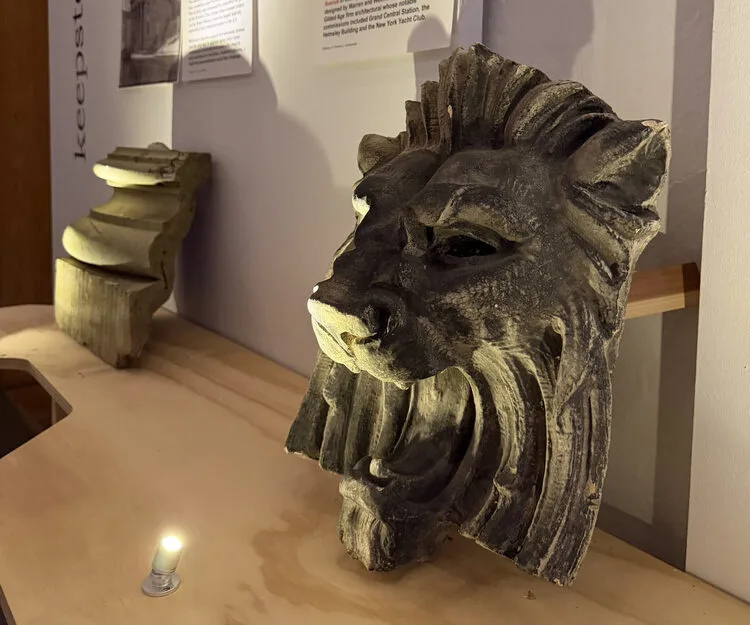
The Keepstones of the City exhibition draws from Tom Campanella’s historical collection of architectural and building fragments representing projects of local and national significance. Each object was salvaged from a building or site lost to demolition, and together they trace how American cities have built, abandoned, and sometimes mourned their landmarks. The seven pieces span the nineteenth century to the postwar era, from Gilded Age banks to modernist housing blocks.
The collection includes a concrete block from the Pruitt-Igoe playground in St. Louis. Opened in 1954 and designed by Minoru Yamasaki, its 33 slab blocks embodied Le Corbusier’s ideals of light, air, and green space. Its 1972 demolition prompted Charles Jencks to declare modernism “dead,” but scholars now point to cost-cutting, segregation, disinvestment, and flawed policy rather than design alone.
From Buffalo comes limestone salvaged in 1989 from the ruins of Frank Lloyd Wright’s Larkin Administration Building (1906). Its skylit atrium, early air conditioning, and built-in metal furniture anticipated the modern open-plan office. Razed in 1950 for a parking lot after the Larkin Company and the city declined, its loss galvanized preservationists.
A concrete block from the main runway of Floyd Bennett Field recalls New York’s first municipal airport, built on Jamaica Bay saltmarsh and opened in 1931 with a 600-plane airshow. It failed commercially because the mail contract stayed in Newark, yet it became a favorite of aviation pioneers such as Amelia Earhart, Howard Hughes, and Wiley Post.
A terracotta block with a Vitruvian scroll motif, taken in 1989 with Bob Balder from Roberts Hall, represents Cornell’s College of Agriculture. Stone, Roberts, and East Roberts halls (1906) symbolized the university’s public land-grant mission. Despite National Register and local landmark status, Cornell demolished them in 1986, exposing the limits of local preservation law against state-affiliated institutions.
A pink granite balustrade capital comes from George B. Post’s Erie County Savings Bank (1893), a Renaissance Revival monument to Gilded Age Buffalo’s confidence. Industrial decline, suburbanization, and Title I urban renewal brought its demolition in 1968, and the capital was recovered in 1988 from Lake Erie shoreline fill, where many of the city’s demolished buildings were dumped.
The final piece is a terracotta fragment from an Ionic column of Brooklyn’s Family Court on Schermerhorn Street. Built around 1829 in the Greek Revival style, it served Brooklyn for over a century. As the borough declined and the welfare state expanded, it fell to Robert Moses’s Brooklyn Civic Center urban renewal project, a trade of architectural continuity for modernist planning that preservationists would later challenge.
Together, these fragments tell a story of ambition, neglect, and loss. They show how economic collapse, racial inequality, and shifting policy shaped the built environment, and how the preservation movement emerged from the rubble to ask what a city owes its past.
Kaynak: events.cornell.edu