Overt Listening (2026): A Screening and Conversation with Tiffany Sia
Stanford Cinematheque, a graduate student-run film collective based in the Department of Art & Art History, presents a screening of Overt Listening, followed by a discussion with filmmaker Tiffany Sia.
About the Film
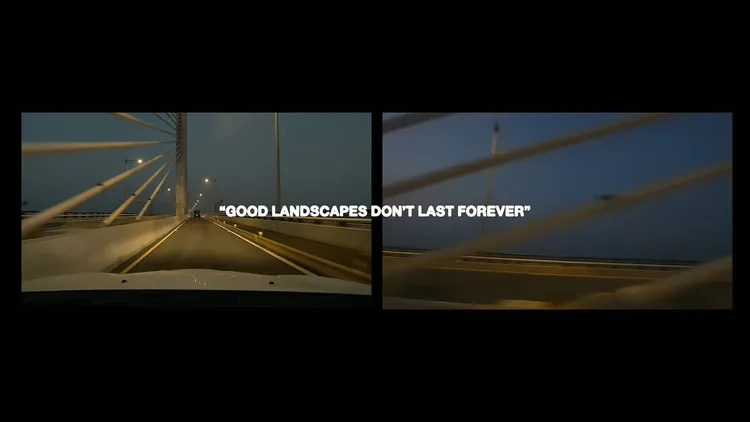
Kinmen is a cluster of Taiwanese islands several kilometers from the Chinese coastline. It is also a national park. Overt Listening (2026) is Tiffany Sia's debut feature-length film, an essay film without voiceover that moves through Kinmen's pristine shorelines, roadside bunker attractions, underground military tunnels, and traffic circles centering statues of Chiang Kai-shek and Sun Yat-sen, myriad sites preserved by Taiwan's national park services that attempt to calcify the territory's Cold War history into spectacle and memorial. In place of spoken language, the film works through the intertitle—owing to early cinema's grammar of silent film—as an interstitial voice: at once historical record, suppressed testimony, and what the landscape doesn't show. While 1989 through 1991 are commonly regarded as the years global Cold War tensions eased, Overt Listening works to discern a more difficult-to-read, ongoing paradigm. The film relies on various aural presences—ranging from silence, signal, noise, and song—where military activity is distantly heard but not seen, and silence is loaded, itself unpeaceful.
About the Filmmaker
Tiffany Sia (b. 1988) is an artist, filmmaker, and writer. Sia's films have screened at the New York Film Festival, Toronto International Film Festival (TIFF), MoMA Doc Fortnight, the Flaherty Film Seminar, and elsewhere. She has had solo exhibitions at Artists Space, New York; the Cantor Arts Center at Stanford University; and MUDAM Luxembourg. Her work has been included in group exhibitions at the Museum of Modern Art, New York; MoMA PS1, New York; the Hessel Museum of Art, Bard College, Annandale-on-Hudson; Argo Factory: Pejman Foundation, Tehran; the Seoul Museum of Art; Kunstverein für die Rheinlande und Westfalen, Düsseldorf; and elsewhere. Sia is the author of On and Off-Screen Imaginaries (Primary Information, 2024), a collection of essays that makes the case for the possibility of cinema after place. Her writing has appeared in Film Quarterly, October, and other publications. She is the recipient of the Art Basel Awards Emerging Artist Medal (2026), the Baloise Art Prize (2024), and the George C. Lin Emerging Filmmaker Award (2021). She has presented lectures at Dia Art Foundation, Stanford University, and Yale University, and has taught at Cooper Union. Her work is held in the permanent collections of the Museum of Modern Art, New York; the Walker Art Center, Minneapolis; and mumok – Museum moderner Kunst Stiftung Ludwig Wien, Vienna.
Working across film, video sculpture, and publications, Sia reconfigures cinematic tropes—from road movies, landscape films, travelogues to documentary reportage—to understand the conditions through which images and texts produce historical knowledge. Her practice attends to how visual and linguistic representation, historical periodization, and the legal material condition of the moving image shape the circulation of images. Focusing on territories shaped by Cold War partition and its unresolved sovereignties, she traces how law, geography, and media structure the production and authority of historical narratives. Her debut feature-length film, Overt Listening (2026)—both a landscape film and a voiceless essay film—world premiered at the New York Film Festival and is the subject of solo exhibitions at Kunsthalle Wien, Vienna, and KW Institute for Contemporary Art, Berlin, co-commissioned by both institutions. Sia is currently at work on They Prefer Us When We're Dead, to be published by no place press (MIT). She lives and works in New York.
This event is generously co-sponsored by the Department of Modern Thought and Literature, the Asian American Research Center at Stanford, and the Department of Music.
Visitor Information
Oshman Hall is located in the McMurtry Building on Stanford campus at 355 Roth Way. Visitor parking is free after 4pm on weekdays, except by the Oval. Alternatively, take the Caltrain to Palo Alto Transit Center and ride the free Stanford Marguerite Shuttle. If you need a disability-related accommodation or wheelchair access information, please contact Julianne White at [email protected]. This event is open to Stanford affiliates and the general public. Admission is free.
Kilde: events.stanford.edu
Mer på McMurtry Building
Alle arrangementer på McMurtry Building
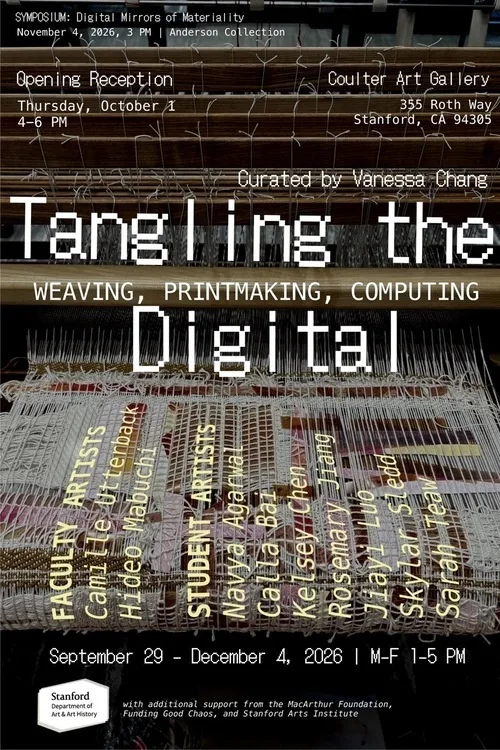 Tangling the Digital: Weaving, Printmaking, Computing
McMurtry Building · Palo Alto