Social Learning and Technological Change: American Agricultural Fairs | History of Capitalism Research Workshop
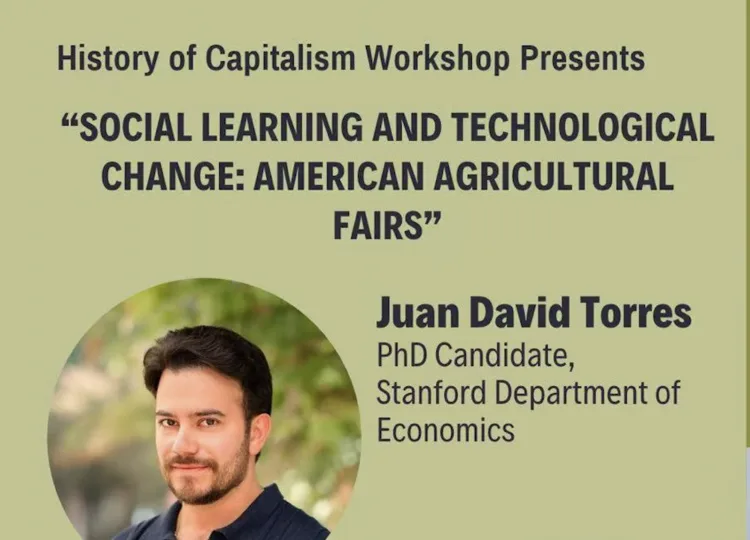
Join the History of Capitlaism Research Workshop for an engaging academic event feauting Juan David Torres and Professor James Campbell. This stimulating conversation will explore agricultural productiy, innovation, and history!
The diffusion of new ideas is central to long-run productivity growth, but it can be constrained by costly information, limited credibility, and uncertainty about local returns. These frictions are especially salient in agriculture, where geographic dispersion and distrust in top-down advice limit the flow of ideas. I study whether social learning can scale to overcome these barriers using American agricultural fairs, the largest experiment of farming gatherings in modern history. Promoted since the 1840s by farmers, entrepreneurs, and state boards of agriculture, county and state fairs brought rural households together annually, combining prizes for crops and practices with exhibitions of frontier implements and methods. I assemble new data on fair expansion across 2,000 eastern U.S. counties between 1850 and 1930 and link them to agricultural censuses and patent records. Using the rotation of state fair locations before permanent designation and the staggered entry of county fairs, I find that permanent state fair hosting increased land productivity and total factor productivity in host and neighboring counties, with effects that attenuated over time. County fairs generated more localized and persistent gains in productivity and patenting, especially where prior signals about technologies were noisier, social networks were sparser, and attendance costs were lower. To study mechanisms, I construct new data on state fair awardees, technology exhibitors, and county society officers, and link them to their farms in the agricultural census. I argue that fairs created variation in exposure to different delivery agents of agricultural information. Learning appears strongest around recognized crop producers: neighboring farms converged toward their production choices and exhibit higher productivity, while similar patterns do not appear around other fair-associated actors. To study broader diffusion, I show that technologies first displayed at fairs subsequently appeared more often in local newspapers. The evidence suggests that fairs increased productivity by making useful knowledge credible and locally portable.
Please RSVP here: RSVP
This event is sponsored by the Patrick Suppes Center for the History & Philosophy of Science.
Источник: events.stanford.edu
Ещё в Building 200, History Corner
Все события в Building 200, History Corner Galicia's Promised City with Oskar Czendze
Building 200, History Corner · Stanford
Бесплатно